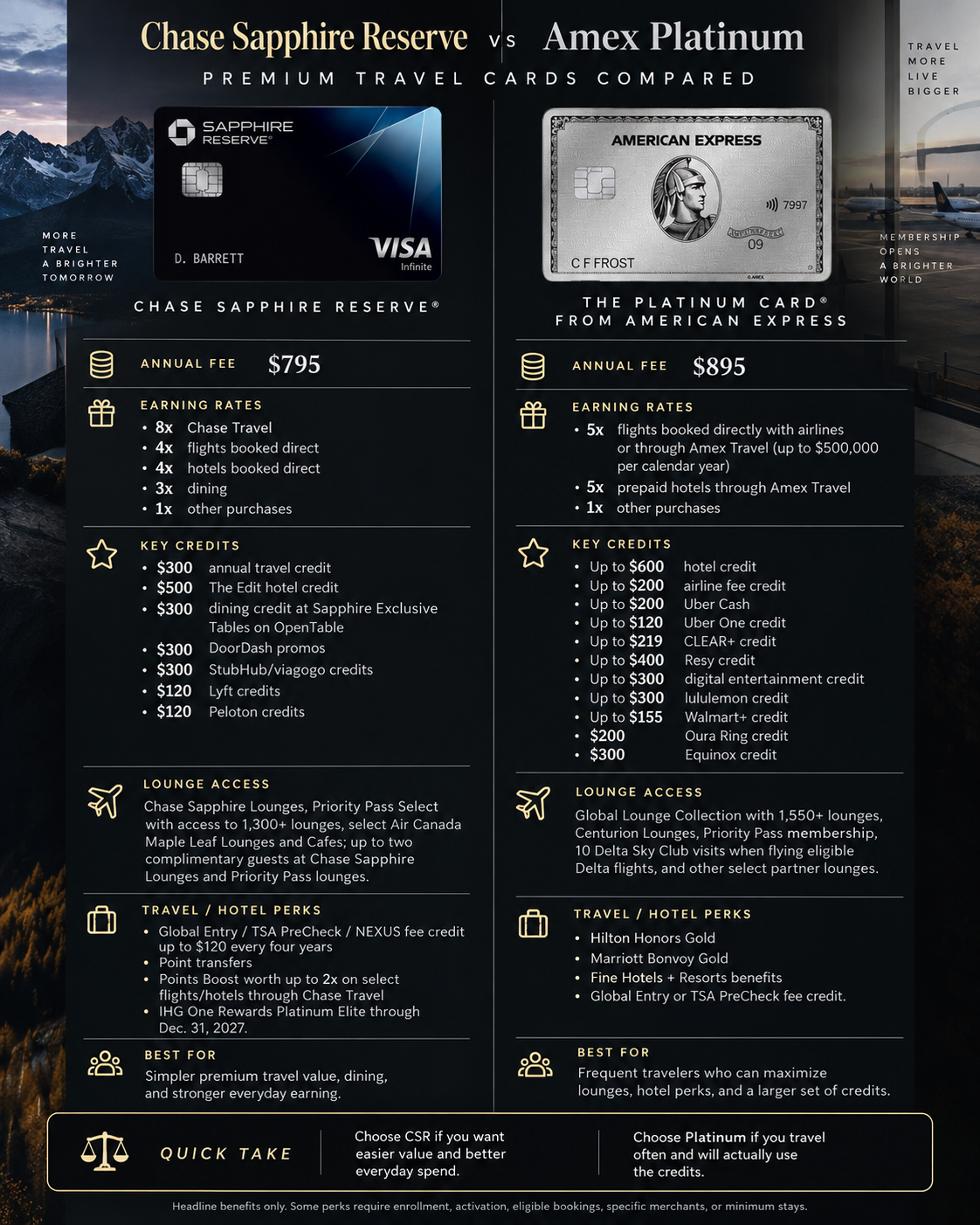


The Chase Sapphire Reserve has a $795 annual fee, so I've stopped treating its benefits like bonuses.
They're part of the math.
One of the most interesting additions to the card is its $300 annual dining credit through Sapphire Reserve Exclusive Tables on OpenTable. But unlike the Reserve's extremely easy $300 travel credit, this one requires a little more planning.
The good news is that if you live in San Francisco, this might be one of the easier cities in the country to actually use it well.
The current San Francisco collection includes restaurants ranging from Saison and Californios to Angler, along with places such as House of Prime Rib, State Bird Provisions, Rich Table and Niku Steakhouse.
For someone who already eats out in San Francisco, that's an important distinction.
I don't need to invent a reason to use this credit. I just need to redirect $300 of dining I was probably going to do anyway.
First: It's Actually Two $150 Credits
The "$300 dining credit" headline makes the benefit sound simpler than it is.
Chase gives Sapphire Reserve cardholders:
- Up to $150 from January 1 through June 30
- Another $150 from July 1 through December 31
Unused credit from the first half doesn't roll into the second.
So I don't think of this as a $300 annual benefit.
I think of it as:
One subsidized dinner every six months.
That's much easier to manage.
Chase automatically reimburses eligible purchases at participating Sapphire Reserve Exclusive Tables restaurants when you pay with your Reserve. You don't have to spend the entire $150 at once, either. Multiple qualifying purchases can add up to the $150 semiannual maximum.
You Don't Have to Book a "Special Chase Dinner"
This is probably the most important thing to understand.
The OpenTable partnership has two related benefits.
First, Sapphire Reserve cardholders can get access to Exclusive Tables, including reservation inventory that may not be available to ordinary OpenTable users.
Second, dining at participating restaurants triggers the statement credit.
To access the special reservation inventory, Chase says you need to add an eligible Sapphire Reserve to your OpenTable account. Once it's verified, Sapphire Reserve Exclusive Tables reservations become available when applicable.
But I wouldn't make the reservation access the main reason to care about this benefit.
For me, the $150 reimbursement is the bigger deal.
The San Francisco Strategy: Don't Chase the Credit
This is where credit-card optimization can get silly.
Suppose I have $150 of Chase dining credit expiring in June.
I could look at the Exclusive Tables list, find an expensive restaurant I've never wanted to visit, spend $350 and proudly tell myself that I "saved $150."
Except I didn't.
If I wouldn't have spent the $350 without the credit, Chase didn't save me money.
It encouraged me to spend $200.
I'd rather look at restaurants I already want to visit and see whether any happen to participate.
San Francisco makes that relatively easy.
House of Prime Rib Might Be the Most Interesting Use
House of Prime Rib is exactly the type of restaurant that makes this benefit interesting to me.
It's an actual San Francisco institution, and reservations can be frustratingly difficult to get.
It's also currently included in the San Francisco Sapphire Reserve Exclusive Tables collection.
That means there are potentially two layers of value.
I may get access to reservation inventory through my Sapphire Reserve.
And when I actually eat there and pay with the card, up to $150 of my available semiannual dining credit can come back as a statement credit.
That's much more compelling than a credit that forces me into a restaurant I wouldn't otherwise visit.
If dinner for two is something I already wanted to do, I'm essentially redirecting part of the Reserve's $795 annual fee back toward a real expense.
That's how I want premium-card credits to work.
Or Use It to Take the Edge Off an Expensive Dinner
There's another approach.
San Francisco has no shortage of very expensive restaurants.
The Exclusive Tables list currently includes places such as Saison and Californios.
If I were already planning one of those meals for a birthday, anniversary or other occasion, using the Reserve is almost automatic.
The $150 credit isn't going to make a tasting menu inexpensive.
But that isn't really the point.
If the dinner was happening anyway, the credit represents a genuine $150 reduction in cost.
That's very different from spending $150 solely because Chase gave me a coupon.
Angler Is Another Type of Sweet Spot
Angler is another interesting example.
It's an upscale seafood-focused restaurant on the Embarcadero and is currently part of the Sapphire Reserve collection.
To me, restaurants like this may actually be better targets than the ultra-high-end tasting-menu places.
Why?
Because I don't necessarily need a $700 special occasion to use the credit.
If the restaurant fits a normal nicer dinner I'd already be willing to pay for, I can get much closer to treating the $150 as actual savings.
That's the goal.
My Rule: Value the Credit Based on What It Replaces
Here's how I'd personally value the Sapphire Reserve dining benefit.
If I spend $175 at a participating restaurant I was already planning to visit and Chase reimburses $150:
Value to me: approximately $150.
If I choose a $300 restaurant instead of the $150 restaurant I actually wanted because I have a Chase credit:
Value to me: much less than $150.
And if I realize on June 28 that I haven't used the benefit and force myself to go somewhere just so it doesn't expire:
Potentially zero value.
That might sound overly conservative.
But this is the accounting trick behind a lot of premium credit cards.
Issuers advertise the face value of benefits.
Consumers should calculate the replacement value.
Those numbers aren't always the same.
The Reservation Benefit Could Be More Valuable Than It Looks
There's another element that doesn't fit neatly into a spreadsheet.
Chase says Sapphire Reserve Exclusive Tables can include reservation slots held specifically for eligible cardmembers, including prime dining times that may not appear through the standard OpenTable experience.
In San Francisco, that can matter.
Getting $150 back is easy to value.
Getting a 7:30 p.m. reservation at a restaurant where I otherwise couldn't find one is subjective.
I wouldn't assign it some invented dollar amount and add it to my annual card valuation.
But I would acknowledge that it's useful.
And that's something I like about the OpenTable benefit: the credit and the access can work together.
Don't Forget Which Card You Pay With
There is one easy way to mess this up.
You can have the right restaurant.
You can make the reservation through OpenTable.
You can have $150 of unused dining credit.
And then you can instinctively reach for another card at dinner.
Don't.
Chase requires the qualifying dining purchase to be paid with an eligible Sapphire Reserve to receive the statement credit.
The Reserve also normally earns 3x Ultimate Rewards points on eligible dining purchases.
So once I've decided I'm using my Sapphire dining credit, the Reserve is the card going down with the check.
How I'd Use the $300 Every Year
My strategy is intentionally boring.
Around the beginning of each six-month period, I'd open the Sapphire Reserve section of OpenTable and look at the San Francisco list.
Then I'd ask:
Is there anything here I was already considering?
If yes, that's where the credit goes.
Maybe that's House of Prime Rib.
Maybe it's a nicer dinner at Angler.
Maybe there's an occasion where I was already considering something much more expensive like Saison.
I wouldn't obsess over extracting exactly $150.00 from each period.
If I spend $142 on an organic dinner and leave $8 unused, I'm fine with that.
Spending an extra $50 to avoid "losing" $8 isn't optimization.
It's marketing working exactly as intended.
The $300 Credit Makes More Sense in San Francisco Than It Does Everywhere
When Chase increased the Sapphire Reserve's annual fee to $795, I became much more interested in whether its new credits represented things I would genuinely use.
The OpenTable dining credit passes that test better than I initially expected.
Not because Chase tells me it's worth $300.
But because San Francisco already has enough participating restaurants that I could reasonably spend $300 a year without fundamentally changing how I dine.
That's the standard I care about.
I don't want to change my life to fit my credit card.
I want my credit card benefits to fit expenses I already have.
And if I can turn two dinners I would have paid for anyway into $300 of annual statement credits — while occasionally getting access to a reservation I couldn't otherwise find — the Sapphire Reserve's OpenTable benefit starts looking less like another coupon.
It starts looking like one of the more useful pieces of the card's $795 annual fee.